

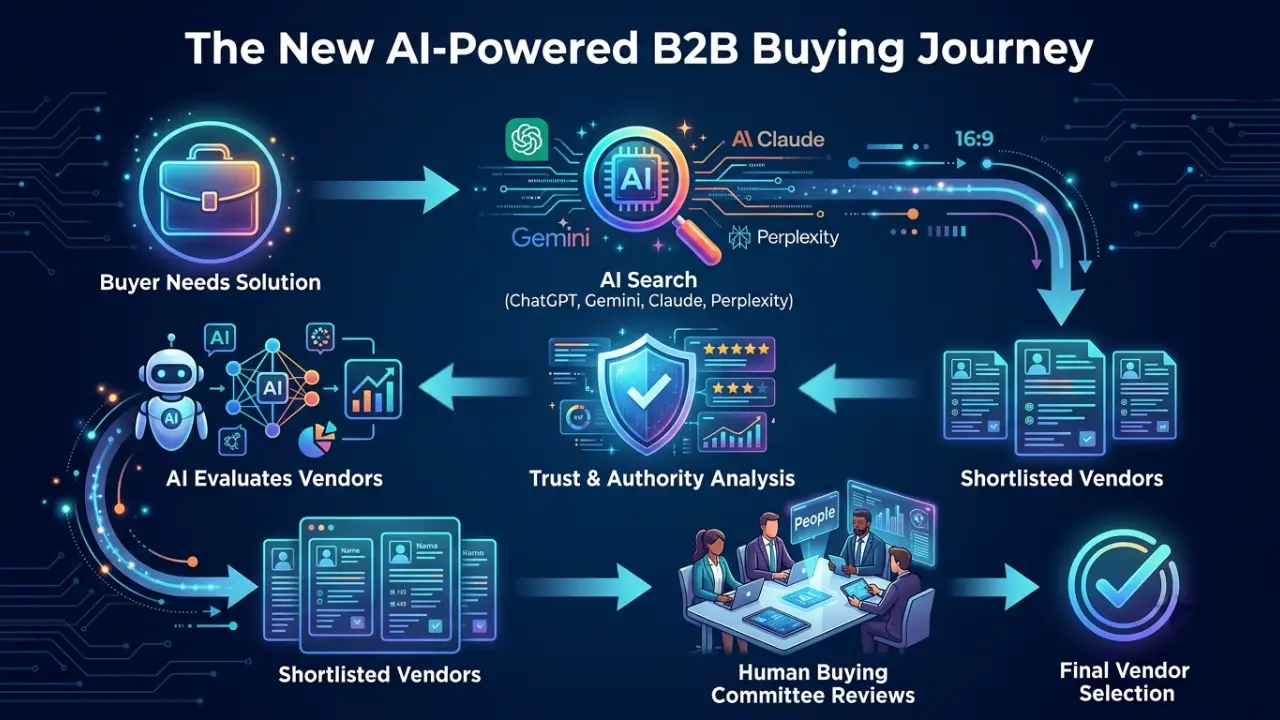
In the high-stakes B2B market, the modern buyer’s primary job is no longer just finding a solution; it is managing corporate risk. Before a procurement officer or executive sponsor signs off on a vendor, they ask themselves one critical question: “Can I defend this decision to the board?” As we navigate 2026, the traditional buying journey has shifted. Buying committees are no longer sorting through endless pitch decks. Instead, they are deploying artificial intelligence as a silent digital gatekeeper to vet your company long before they ever reach out to your sales team. To survive this shift, organizations must adopt a robust AI content governance strategy to ensure their expertise is visible, accurate, and completely undeniable to machine algorithms.
The Silent Consultant: How Artificial Intelligence Filters Your Sales Pipeline
The modern B2B buying group has expanded to include an average of 22 stakeholders, ranging from technical end-users to strict legal and procurement officers. Getting a consensus among nearly two dozen professionals is notoriously difficult. To streamline this friction, buying committees now use large language models and search generative engines as internal consultants. They use AI to analyze market landscapes, summarize vendor capabilities, and compare competing architectures.
If an enterprise buying group asks an AI tool to compile a list of the top vendors capable of solving a highly specific technical challenge, the algorithm will not rely on your generic marketing fluff. It scans the web for structured data, verified case studies, and primary research. If the AI cannot find definitive, parseable proof of your real-world expertise, your organization simply will not make the digital shortlist. You remain completely invisible to a prospect who was a perfect fit for your product or service.
The Rise of AI-Driven Procurement Audits
Procurement teams are increasingly leveraging private AI instances to run risk assessments on prospective vendors. These algorithms evaluate your digital footprint to spot inconsistencies, unverified claims, or gaps in compliance documentation. When your digital presence lacks technical depth, the algorithm flags your brand as a high-liability option, eliminating you from contention before a human ever looks at your website.
Building a Defensible Digital Footprint for Machine Algorithms
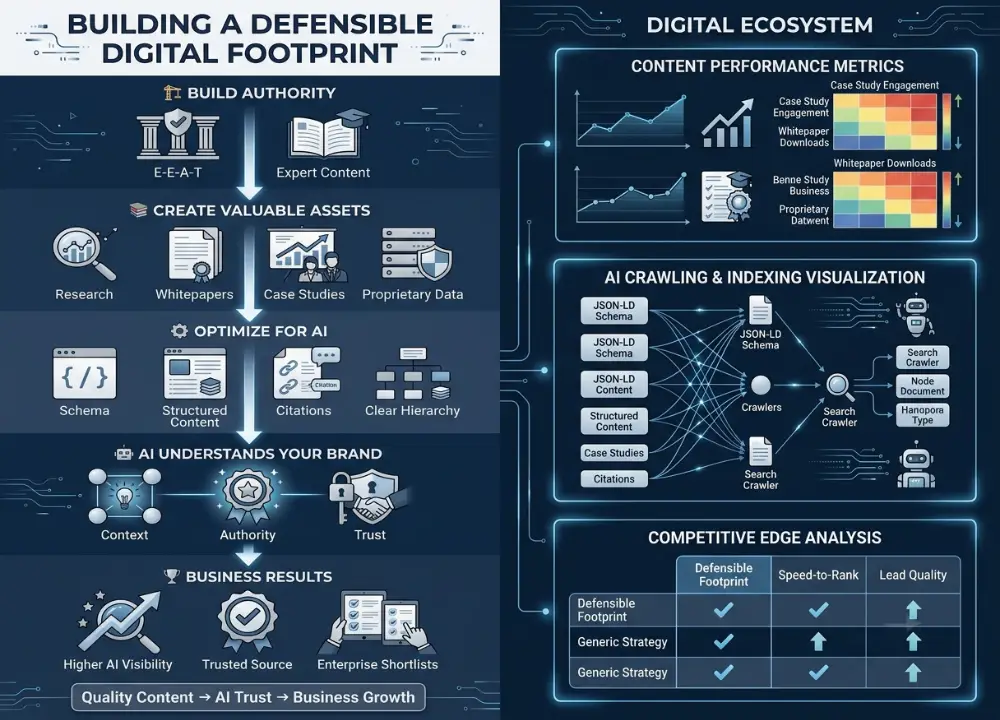
To win the favor of both human buyers and the algorithms they trust, B2B brands must pivot away from raw content volume. Flooding the internet with generic, AI-generated blog posts leads to severe SEO erosion and creates a trail of shallow text that algorithms quickly dismiss as low-effort spam. Instead, your digital optimization strategy must prioritize deep, defensible authority modeled around Google’s E-E-A-T guidelines: Experience, Expertise, Authoritativeness, and Trustworthiness.
Building a defensible digital footprint means publishing data assets that are structurally optimized for machines to ingest and attribute. This requires a shift toward first-hand research, proprietary data sets, and deeply technical whitepapers. When an AI model trains on or searches through your industry’s ecosystem, your brand should stand out as the primary, cited source of truth for your specific niche.
Optimizing for the AI Crawl: Structure and Citations
Large language models rely heavily on clear content structures to understand complex relationships between concepts. By organizing your technical documentation, case studies, and insights with clear semantic hierarchies, you make it seamless for AI crawlers to extract your core arguments. Additionally, citing authoritative external research and linking out to validated industry standards tells the algorithm that your content is grounded in verifiable reality, directly lowering the perceived risk of an AI hallucination.
“As AI-generated content becomes more prevalent, the value of human expertise and unique, first-hand experience increases. Search engines are increasingly prioritizing content that demonstrates ‘real-world’ authority that AI cannot replicate.”
Transforming Case Studies into Irrefutable Proof Points
Traditional B2B case studies are often written as vague narrative stories filled with marketing platitudes. While human readers might tolerate a high-level success story, an AI engine looking for technical proof points will find it completely useless. To ensure your case studies help you land on the modern B2B shortlist, they must be treated as structured data sheets filled with concrete metrics, explicit methodologies, and clear cause-and-effect relationships.
When documenting a customer success story, outline the exact parameters of the technical challenge, the specific deployment steps your team took, and the audited results. Use explicit data points, such as percentage improvements, dollar amounts saved, or time-to-market reductions. This level of granular detail gives the AI consultant the exact factual evidence it needs to confidently recommend your firm to an executive board during the research phase.
Leveraging Schema Markup for Automated Vetting
To maximize the impact of your corporate proof points, implement advanced schema markup across your website. Explicitly tagging your client success stories, technical specifications, and author bios with structured data allows search generative engines to index your site with absolute precision. This technical step ensures that when an AI tool evaluates your corporate capabilities, it pulls the most accurate and compelling metrics directly into the buyer’s generated summary.
The Hallucination Tax and the Critical Need for Absolute Accuracy
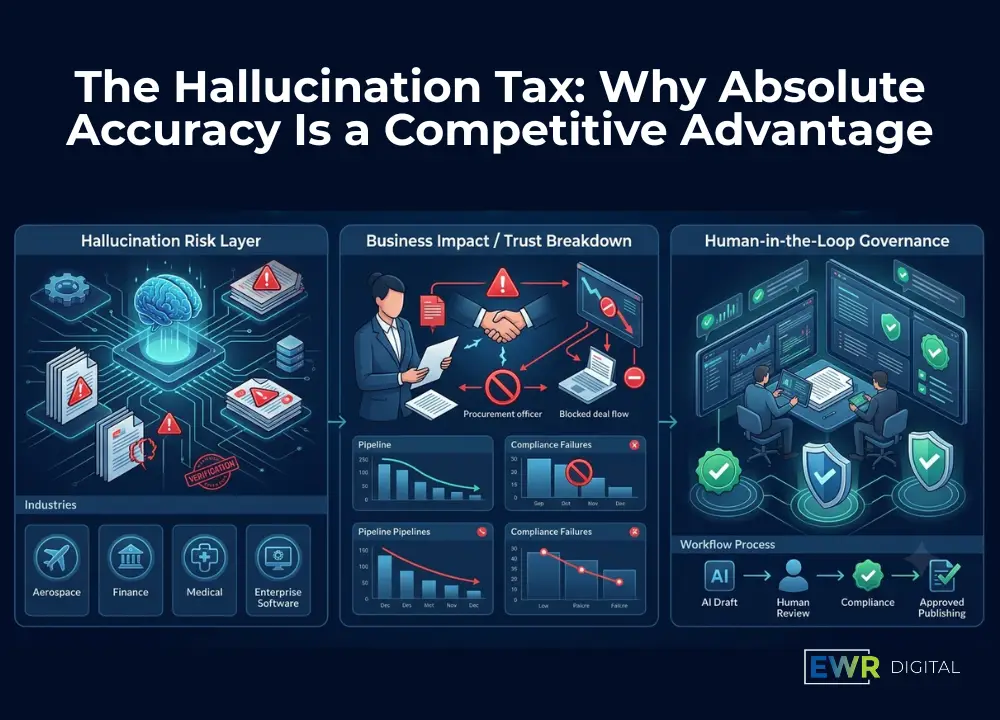
In high-stakes corporate sectors like aerospace engineering, financial services, medical manufacturing, and enterprise software development, the cost of inaccurate information is astronomical. If your digital assets contain unverified specifications or hallucinated facts, you face a massive liability trail. The time and human labor required to manually fact-check sloppy, unverified output is what forward-thinking organizations call the hallucination tax.
Publishing unverified information does not just hurt your search engine rankings; it completely breaks the trust cycle with sophisticated buyers. If a procurement officer catches a single inaccurate claim or a misplaced technical specification in your public-facing documentation, the entire deal comes to an immediate halt. Comprehensive digital information governance acts as a protective shield for your sales pipeline, ensuring that every asset published is legally defensible and factually airtight.
Establishing a Human-in-the-Loop Governance Workflow
Maintaining an unassailable brand reputation requires a strict human-in-the-loop workflow for all digital publishing. While artificial intelligence can assist with formatting or initial drafting, subject matter experts must rigorously review every line of technical content for accuracy. This review process guarantees that your public information satisfies the intense scrutiny of modern search algorithms, corporate legal teams, and compliance auditors alike.
Turn the Silent Consultant into Your Strongest Asset
The B2B buying journey has permanently evolved into an ecosystem where algorithmic verification happens behind closed doors. You can no longer rely purely on the charisma of your sales team to carry a deal across the finish line. If your digital footprint is thin, generic, or unverified, the silent AI consultant will quietly remove your organization from the shortlist before your sales reps ever have a chance to make a pitch.
Winning the digital discovery war requires a proactive commitment to quality, structure, and absolute accuracy. By investing in rigorous information governance and expert-led data assets, you construct an authoritative corporate moat that no algorithm can disrupt. Make sure the silent consultant is actively working on your side. Let us build your undeniable digital authority and secure your spot on the next enterprise shortlist with EWR Digital.